
Junction Court Docket Searches
Start any docket search with the case type. Most traffic matters, infractions, ordinance violations, class B and C misdemeanors, and small claims belong to the Piute County Justice Court. Felonies, class A misdemeanors, ordinary civil litigation, domestic relations, and probate all go to the Junction District Court instead. The statewide Utah Courts Xchange searches public information from both levels in one place, which makes it a practical first stop for a Piute County court docket.
- Collect the case or citation number, party name, year, and likely case type.
- Choose District Court, Justice Court, or both and narrow the location to Piute County.
- Pair the identifier with the court because Utah case numbers are not statewide-unique.
- Open Case History or Extended Case History and review the event sequence.
- Compare the latest setting with the calendar, then telephone the Junction courthouse if needed.
Eligible parties get free access to their own linked matters through MyCourtCase. That is a personal tool, not an open Junction docket search for the public. Attorney eFiling works the same way: a filing channel only.
Junction Is the Court Location
Junction is home to just 212 people, per the 2020 Census. Small as it is, the town carries real weight. It serves as the Piute County seat and the place where court access happens. The Sixth District Court page places the Piute County Courthouse in Junction. The address is 550 North Main, Junction, UT 84740. Mail goes to PO Box 99, Junction, UT 84740. Anyone chasing a Piute County court docket will likely end up here.
Population is not a caseload figure. That is why Junction court records can involve people or events from anywhere in Piute County, even though the courthouse sits inside Junction town limits.
Inside the Junction Municipal Court
Junction runs no municipal court of its own. There is no town judge, citation portal, or local court calendar. What exists instead is the Junction Town Council. The official Utah Public Notice page lists it at 155 North 200 West, PO Box 26, Junction, UT 84740, telephone 435-577-2777. That body posts town-government notices, not Junction court records. The official Junction Town Council public-notice page shows the council as a public body. It also describes the council's notice function.
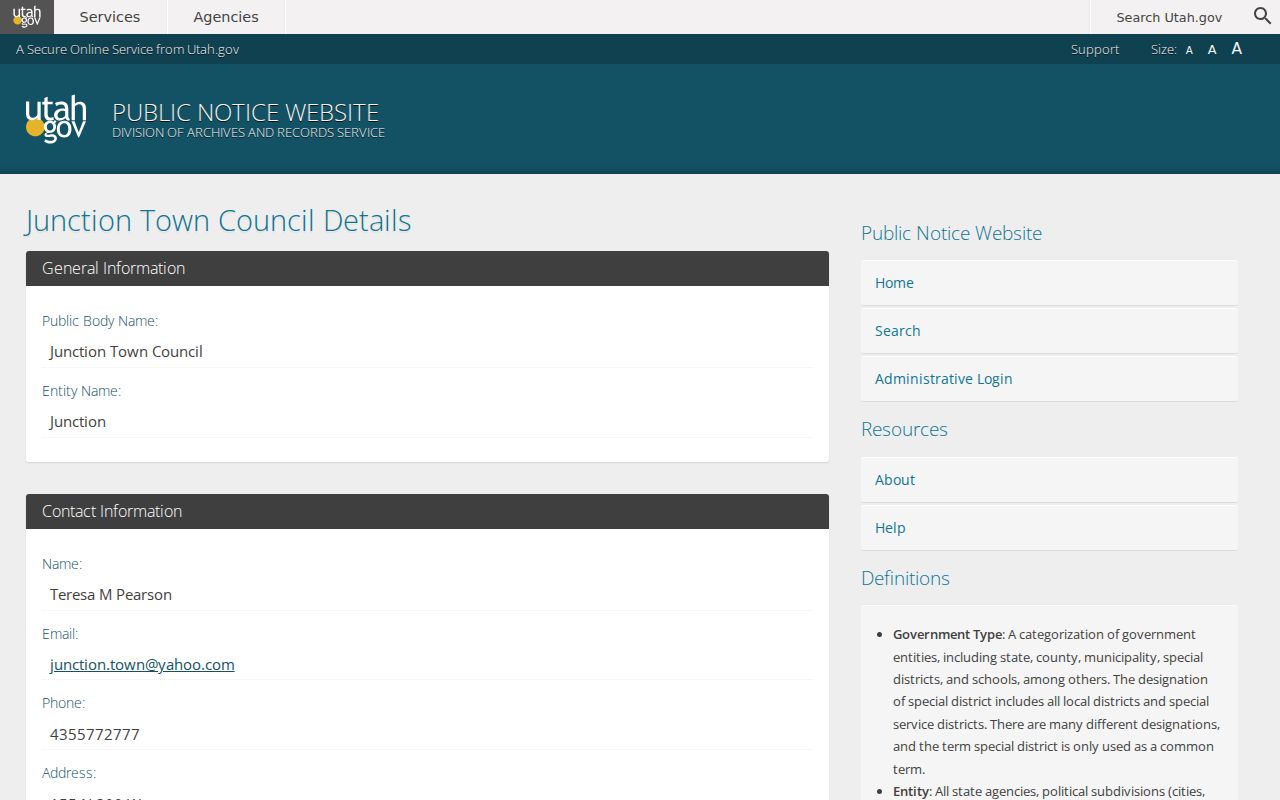
The town page helps locate council records. It does not replace the Justice or District Court sources for Junction court records.
Do not confuse labels: “Junction District Court” is the Utah District Court location in the county seat. It is not evidence of a Junction town-operated municipal court.
Pick Piute County Justice Court for traffic tickets and lower-level matters. Junction District Court handles the heavier cases: criminal, civil, domestic, and probate. If your citation names a different court, the citation wins.
Junction District Calendar Search
The official calendar ties the location to a specific court. It names the Sixth Judicial District for Junction District Court. A search for a chosen date can come back with a no-results message. That blank screen only means nothing matched those criteria at that moment. It is not proof that Junction case history is missing from Xchange. The official Junction District Court calendar result shows the location line. It also shows what an empty result looks like.
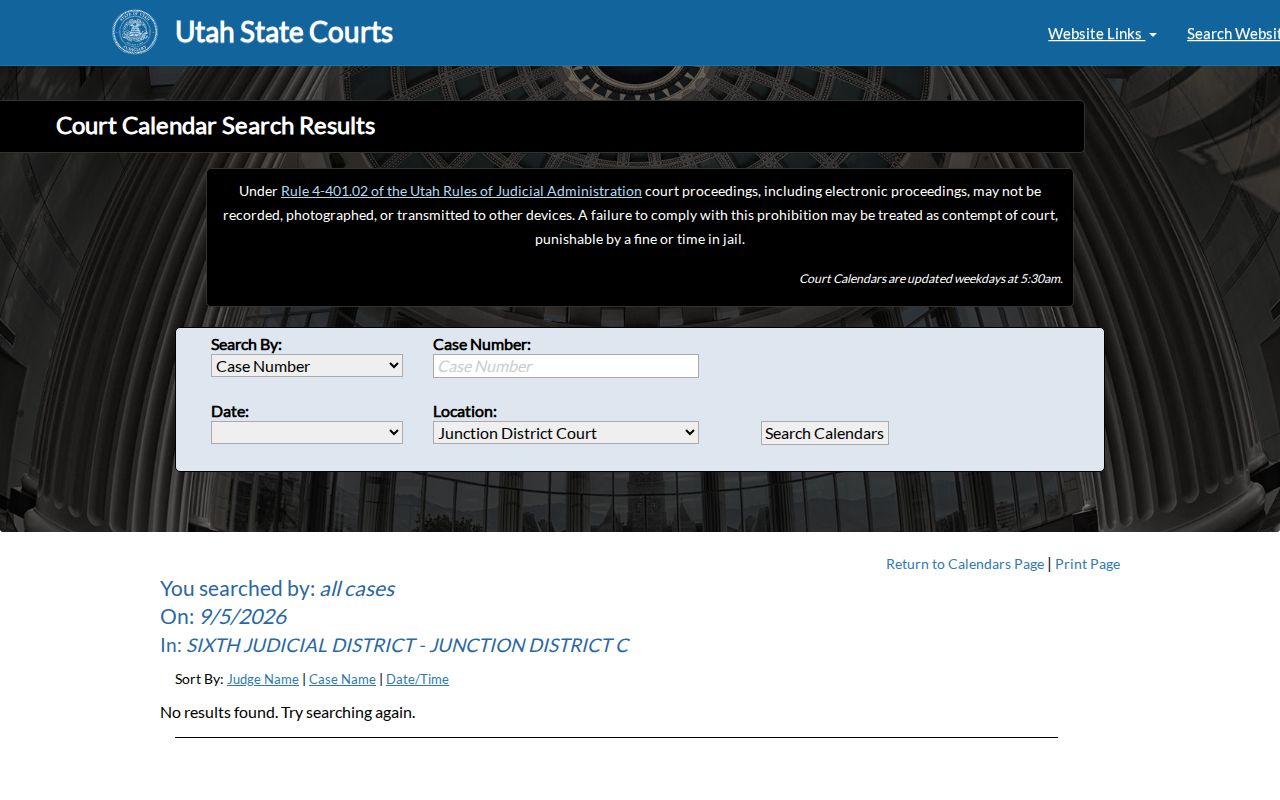
Search controls cover case number, party, judge, and attorney first and last name. Bar number, date, and location round out the fields. Sort results by judge, case name, or date and time. The calendar refreshes on weekdays at 5:30 a.m. A blank result does not mean the case vanished. Test nearby dates before assuming a Junction court date was canceled. Then confirm the location with the Junction clerk or Xchange.
Finding Junction Court Dates
Use the Utah Court Calendars layer for settings, then compare it with the newest Xchange proceeding on the case. Select Junction District Court for District cases or Piute County Justice Court for lower matters; the shared building does not blur the two dockets. The county warns that appearances are by schedule only, with no open court available.
| Date | The currently posted hearing date, subject to a later reset. |
|---|---|
| Time | The stated setting time or calendar call. |
| Courtroom | The Justice Court or Junction District location. |
| Judge | The presiding judge listed for the event. |
| Setting Type | Arraignment, pretrial, trial, review, or another hearing. |
Call 435-577-2840 before you travel. When a new entry, continuance, or cancellation may not yet be clear online, the main number is the safer way to confirm a hearing.
Junction Courthouse Then and Now
The adobe courthouse went up in 1903, built by hand. Piute County offices used it until 1997. The building earned a spot on the National Register in 1971. Work on the replacement at 550 North Main started in 1996, and doors opened the next year. That timeline matters for anyone tracing an old Junction court record. Case files created decades ago may still carry the earlier courthouse's name, even though traffic today heads to North Main.
None of this history shifts who keeps the records. It does not turn town paperwork into court paperwork. Current case data runs through CORIS and Xchange. Older material on paper or microfilm, though, may sit in storage rather than any database. Ask the clerk directly for a Junction court docket. That applies to anything predating the local switch to electronic files.
Junction Traffic Ticket Lookups
Junction traffic tickets normally start in Piute County Justice Court. But the citation itself controls. Read it to see if it names a different venue. Xchange offers several search fields. Citation number and location is one. Case number, party name, case type, court scope, and date range also work. Two prefixes matter here. TN pulls up a Traffic Citation search, while TC finds a Traffic Court Case. Parking works the same way, with PN for parking citations and PC for parking cases.
Utah ePayments takes a case number or citation number. You confirm the name on the screen before paying. That tool covers payment only, not the wider Junction court record. Paying a ticket is one thing; contesting it is another. Either way, the deadline printed on the citation still controls. If your lookup comes up empty, that is not a dismissal. It does not let you skip a court date. The county-wide Piute traffic court resource walks through the steps for citations and court dates.
The Junction Shared Clerk Model
Judicial Council material lays out how the shared clerk model works in Piute County. One clerk operation at the Junction courthouse serves both court levels. The Sixth District Court side keeps the criminal, civil, domestic, and probate files. The county side handles Justice Court work. Lower criminal cases, traffic, and ordinance matters sit there. Small claims do too. The building gives visitors a single place to go. But the two jurisdictions remain separate.
| Feature | Justice Court | District Court |
|---|---|---|
| Typical Junction matters | Traffic, infractions, lower misdemeanors, small claims | Felonies, class A misdemeanors, general civil, domestic, probate |
| Calendar label | Piute County Justice Court | Junction District Court |
| Public history | Xchange | Xchange |
When you ask the clerk for a docket search, name the court level you need. A name by itself can pull misleading hits, since the same year and number pattern can show up elsewhere in Utah.
How Junction Cases Reach the County
Junction already hosts the county courts, so many local cases land in the right venue from day one. Lower matters start in Piute County Justice Court. A felony, a class A misdemeanor, or a broader civil claim starts instead in District Court. Appeals add a wrinkle. A case appealed from Justice Court creates a District Court record. The upper level can still matter. That holds even after the lower docket shows a final outcome.
Docket flow: Junction citation or filing › Piute County Justice Court or Junction District Court › Utah District Court, Sixth District Court, Piute County
No verified Junction municipal court appears in this flow. For county-wide routing, the Piute County court docket overview covers the picture without repeating the building details.
Junction Case History Fields
An Xchange result for a Junction case can list the county, court location, case type, case number, filing date, party names, a birth date where displayed, and a party code. Links lead to Case History or Documents. Open the full record and you may find the case style, current judge, status, charges or civil claims, attorneys, a chronological list of proceedings, accounting, and public images.
- Case history
- The public summary of parties, events, hearings, documents, judgments, and outcome.
- Minute entry
- A record of courtroom activity, not always a complete transcript.
- AP
- An appealed disposition or judgment code.
- TR
- A transferred case status.
Follow the whole sequence, not just the last code on the docket. A hearing entry only sets a date, while a judgment or disposition records the outcome. For certified proof, the clerk is still the one to ask.
Junction Certified Court Copies
Utah's Request for a Record form covers inspection, plain copies, certified copies, exemplified copies, audio, and older Junction files. List the court level and case number. Add the document, date range, delivery choice, your contact details, and any fee-waiver request. Looking at a public file costs nothing. Fees run $0.25 per paper sheet and $0.10 per electronic page. Certified copies cost $4 per document plus $0.50 per page. Exemplified copies run $6 per document plus $0.50 per page. Staff research time can be billed after the first 15 minutes. The courthouse lists fax 435-577-2433 and Utah Relay 711. Call to confirm how to submit. Collette Teichert is published as a jury contact. Her records role is not established.
Who Can See Junction Court Records
Utah's rules open public Junction court records to anyone. Sealed, expunged, private, protected, juvenile, adoption, civil commitment, and similar categories stay out of ordinary Xchange results. A missing hit has other causes too. The entry may be new, the court level wrong, or the file an older pre-CORIS record.
Key rules:
UCJA Rule 4-202.03 defines the public-access right and restricted paths.
UCJA Rule 4-202.04 governs specific written clerk requests and denial review.
UCJA Rule 4-202.08 supplies uniform service and copy-fee authority.
If you need something you can formally rely on, order the certified Junction document from the court clerk. Xchange and the calendar are finding tools only, never a stand-in for the certified file.
Junction Counter and Terminal Access
The Junction courthouse is the physical fallback, since both county court levels operate there. Utah Courts notes that most district courthouses offer free Xchange. Some Justice Courts may too. Piute terminal availability is not guaranteed, and the notice covers only the schedule, so call first. A public terminal cannot open a restricted case. Come prepared with a case number. Bring party spelling, court level, year, and a description of the document. If the screen shows the history but you need official proof, ask for certification. No match? Ask staff about CORIS conversion and older files. Keeping Justice and District requests separate helps the shared clerk pull the right Junction file.
Junction State and Federal Boundaries
A Piute state case stays at the Junction courthouse unless a Utah court orders another venue. Federal matters go elsewhere: the United States District Court for the District of Utah, with records through PACER and no Piute connection. The Junction clerk does not keep federal filings. Xchange reaches Utah District and Justice Courts only. Check jurisdiction before you widen a failed docket search. A town council notice, a state history, and a federal docket each sit with separate offices and separate keepers.